Protocols
Protocols by Elizabeth A. Ronan, sorted in reverse chronological order.
Reproducible science starts here.
Accessible protocols I've refined for sensory encoding research across several model systems.
2026
-
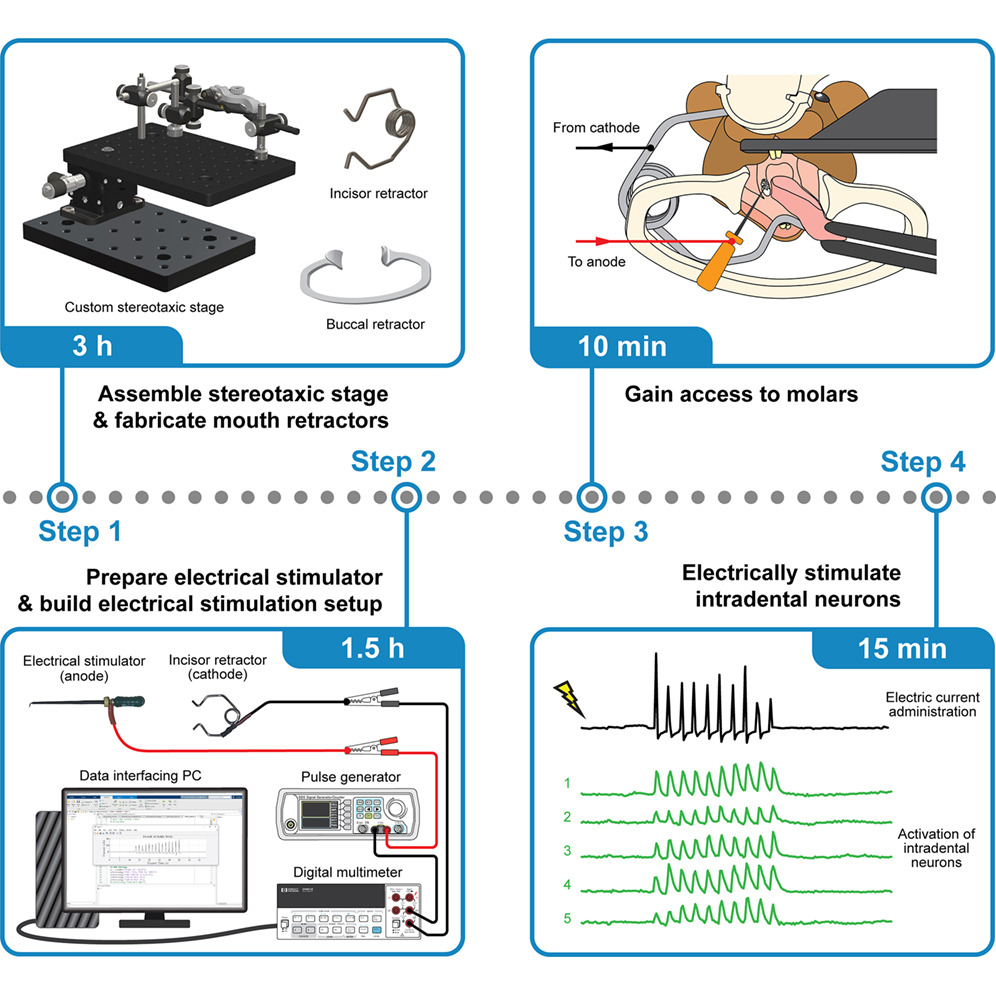 Protocol for the precise activation of intradental neurons in mice via electrical stimulationSTAR Protocols, Mar 2026
EXPAND ABSTRACT
Summary: Intradental neurons encode tooth sensation, yet identifying them without sacrificing tooth structural integrity remains challenging. Here, we present a protocol for the non-invasive electrical stimulation of intradental neurons with single-molar tooth resolution in anesthetized mice. We describe details for head fixation to access molars. We then provide steps to deliver direct current (DC) pulses to an individual molar while simultaneously monitoring induced current. The protocol can be combined with neural imaging to identify and characterize intradental sensory responses and circuits.
2024
-
 Characterization of auditory sensation in C. elegans.Biophysics Reports, Dec 2024
EXPAND ABSTRACT
Cover story: Research using the model organism nematode C. elegans has greatly facilitated our understanding of sensory biology, including touch, olfaction, taste, vision and proprioception. While hearing had long been considered to be restricted to vertebrates and some arthropods, we recently discovered that C. elegans is capable of sensing and responding to airborne sound in a frequency and sound source-size dependent manner. C. elegans auditory sensation occurs when airborne sound physically vibrates their external cuticle (skin) to activate the sound-sensitive mechanosensory FLP/PVD neurons via nicotinic acetylcholine receptors (nAChRs), triggering aversive phonotaxis behavior. Here, the authors report stepwise methods to characterize these three features of C. elegans auditory sensation, including sound-evoked skin vibration, neuronal activation, and behavior. This approach provides an accessible platform to investigate the cellular and molecular mechanisms underlying auditory sensation and mechanotransduction mechanisms in C. elegans.
2023
- Surgical window preparation to visualize the trigeminal ganglion in an anesthetized mouseApr 2023
EXPAND ABSTRACT
Summary: The trigeminal ganglion houses somatosensory neurons that innervate peripheral structures throughout the head and face. This protocol describes step-by-step instruction to perform a non-survival surgery for visualizing the ganglia. We apply this procedure to record calcium responses from the mouse trigeminal sensory neurons in vivo.