Research Articles
Publications by Elizabeth A. Ronan, sorted in reverse chronological order.
Orofacial Somatosensation (Emrick Lab, Postdoc)
2026
- A touch-guided neural circuit regulates motivated gnawing to maintain dental alignmentNeuron, Mar 2026Epub ahead of print
EXPAND ABSTRACT
Abstract: How hindbrain circuits integrate peripheral and central signals to regulate complex oral behaviors is poorly understood. In rodents, gnawing is essential for localized tooth wear to offset lifelong incisor growth. Whether this process relies on specific sensory input to guide localized tooth wear and is actively regulated by neural mechanisms remains unresolved. Here, we identify somatostatin-expressing neurons in the spinal trigeminal nucleus oralis as a central relay distributing tactile input to motor execution and motivational circuits. These neurons receive input from a genetically distinct population of S100b+ A-beta low-threshold mechanoreceptors that innervate the incisor periodontium and project to both jaw-closing motor neurons and, via the parabrachial nucleus, the ventral tegmental area. Disruption of this pathway abolished gnawing and resulted in severe malocclusion, while activation triggered dopamine release in the nucleus accumbens. Our findings redefine dental alignment as an active, touch-dependent, circuit-governed process and reframe malocclusion as a sensorimotor-motivational integration disorder.
2025
-
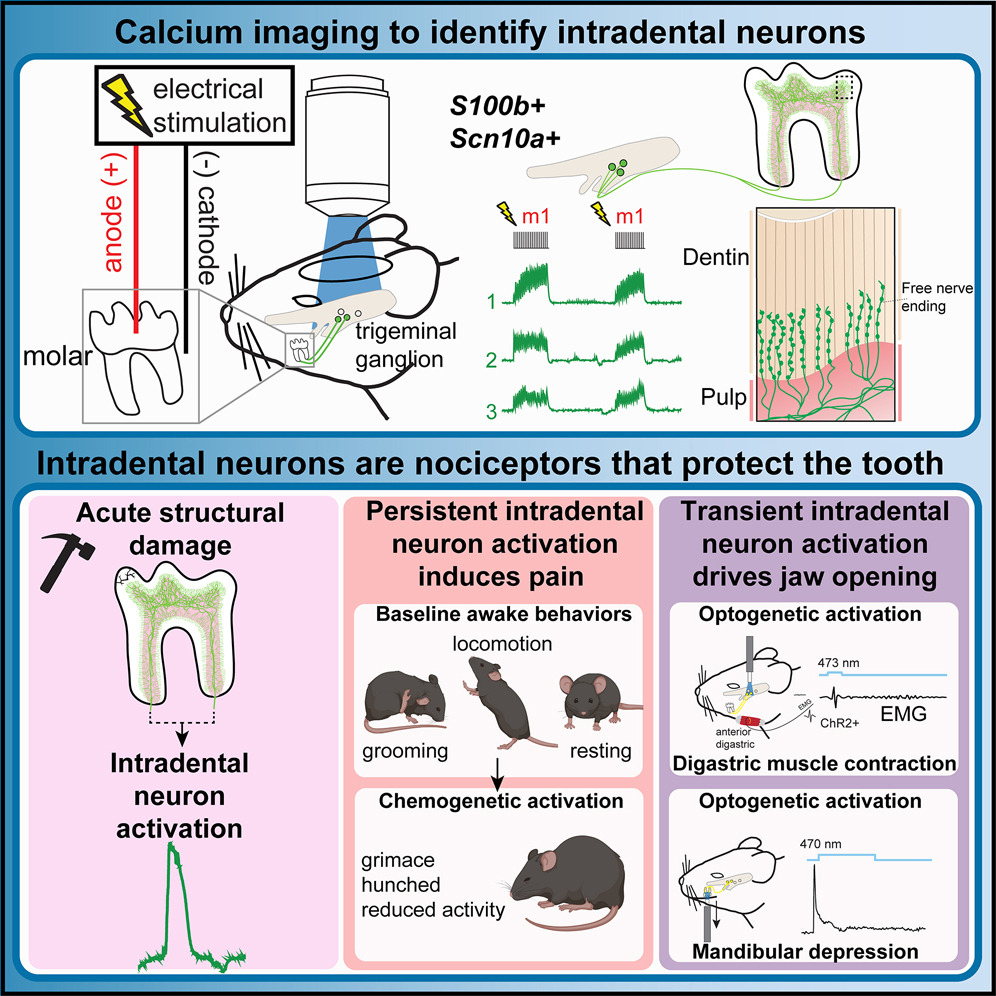 Intradental mechano-nociceptors serve as sentinels that prevent tooth damage.Cell Reports, Aug 2025
EXPAND ABSTRACT
Abstract: The trigeminal sensory neurons that innervate the tooth’s vital interior—intradental neurons—are expected to drive severe pain, yet their contribution to healthy tooth sensation has not been explored. Here, we uncover a role for myelinated high-threshold mechano-nociceptors (intradental HTMRs) in tooth protection using in vivo Ca2+ imaging, opto-/chemogenetics, and the AI-driven behavioral analysis tool LabGym. Intradental HTMRs innervate the inner dentin through overlapping receptive fields and respond as the external structures of the tooth are damaged in the absence of either PIEZO2 or Nav1.8. Whereas chemogenetic activation of intradental HTMRs results in a pain phenotype marked by facial and postural changes, their transient optogenetic activation triggers a rapid, jaw-opening reflex via contraction of the digastric muscle. Our work indicates that intradental HTMRs not only trigger pain but also protect the teeth by initiating a reflexive movement of the jaws when the teeth experience damage during chewing.
C. elegans Sensory Biology (Xu Lab, PhD)
2025
- Dietary cinnamon promotes longevity and extends healthspan via mTORC1 and autophagy signaling.Aging Cell, Apr 2025
EXPAND ABSTRACT
Abstract: Cinnamon, renowned for its aromatic flavor, represents one of the most widely used spices worldwide. Cinnamon is also considered beneficial to human health with therapeutic potential for treating various diseases, ranging from diabetes and cancer to neurodegenerative diseases. However, the mechanisms underlying cinnamon’s health benefits remain elusive. It is also unclear whether cinnamon has any role in aging. Using C. elegans as a model, here we show that feeding worms cinnamaldehyde (CA), the active ingredient in cinnamon oil, prolongs longevity. CA also promotes stress resistance and reduces beta-Amyloid toxicity in a C. elegans model of Alzheimer’s disease. Mechanistically, CA exerts its beneficial effects through mTORC1 and autophagy signaling. Interestingly, CA promotes longevity by inducing a dietary restriction-like state without affecting food intake, suggesting CA as a dietary restriction mimetic. In human cells, CA exerts a similar effect on mTORC1 and autophagy signaling, suggesting a conserved mechanism. Our results demonstrate that dietary cinnamon promotes both lifespan and healthspan and does so by regulating mTORC1 and autophagy signaling.
2023
-
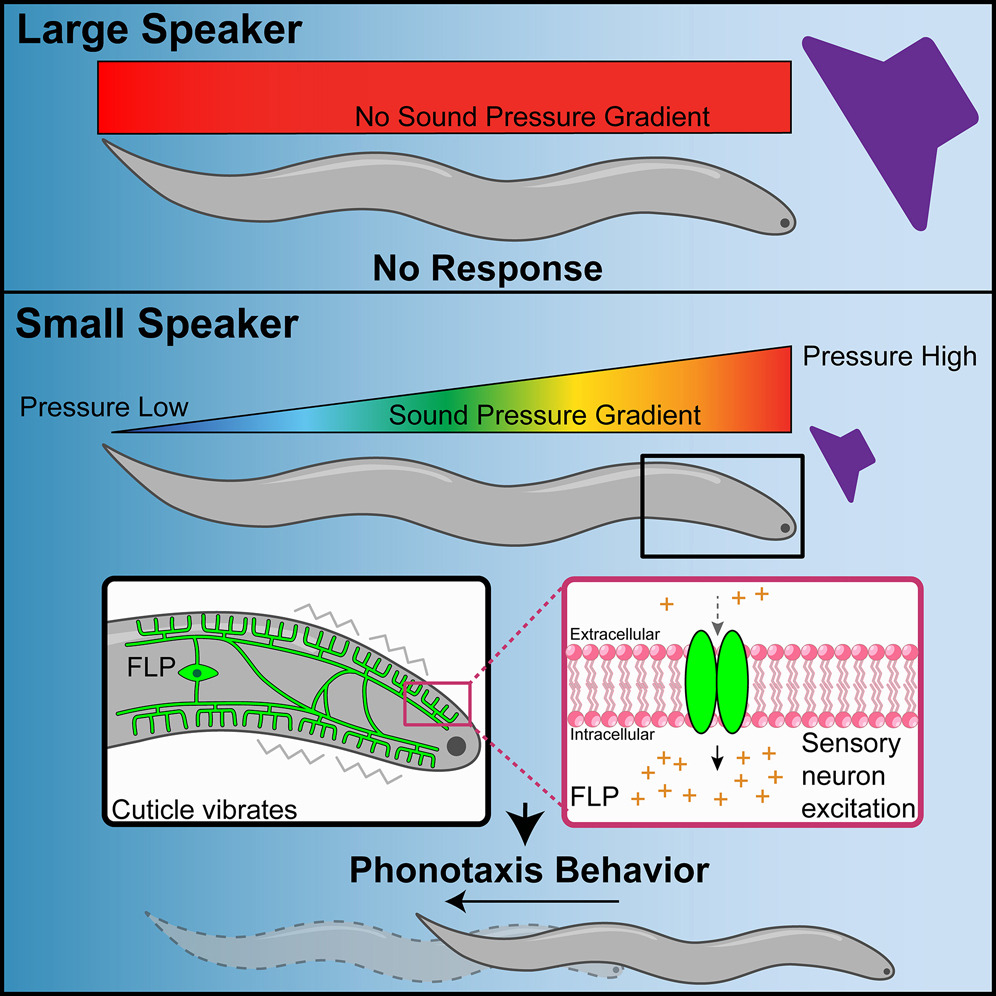 Sensing of sound pressure gradients by C. elegans drives phonotaxis behavior.Current Biology, Sep 2023
EXPAND ABSTRACT
Abstract: Despite lacking ears, the nematode C. elegans senses airborne sound and engages in phonotaxis behavior, enabling it to locate and avoid sound sources. How worms sense sound, however, is not well understood. Here, we report an interesting observation that worms respond only to sounds emitted by small but not large speakers, indicating that they preferentially respond to localized sound sources. Notably, sounds emitted by small speakers form a sharp sound pressure gradient across the worm body, while sounds from large speakers do not, suggesting that worms sense sound pressure gradients rather than absolute sound pressure. Analysis of phonotaxis behavior, sound-evoked skin vibration, and sound-sensitive neuron activities further support this model. We suggest that the ability to sense sound pressure gradients provides a potential mechanism for worms to distinguish sounds generated by their predators, which are typically small animals, from those produced by large animals or background noise. As vertebrate cochlea and some insect ears can also detect sound pressure gradients, our results reveal that sensing of sound pressure gradients may represent a common mechanism in auditory sensation across animal phyla. - A C. elegans neuron both promotes and suppresses motor behavior to fine tune motor output.Frontiers in Molecular Neuroscience, 2023
EXPAND ABSTRACT
Abstract: How neural circuits drive behavior is a central question in neuroscience. Proper execution of motor behavior requires precise coordination of many neurons. Within a motor circuit, individual neurons tend to play discrete roles by promoting or suppressing motor output. How exactly neurons function in specific roles to fine tune motor output is not well understood. In C. elegans, the interneuron RIM plays important yet complex roles in locomotion behavior. Here, we show that RIM both promotes and suppresses distinct features of locomotion behavior to fine tune motor output. This dual function is achieved via the excitation and inhibition of the same motor circuit by electrical and chemical neurotransmission, respectively. Additionally, this bi-directional regulation contributes to motor adaptation in animals placed in novel environments. Our findings reveal that individual neurons within a neural circuit may act in opposing ways to regulate circuit dynamics to fine tune behavioral output.
2021
- The nematode C. elegans senses airborne sound.Neuron, Nov 2021
EXPAND ABSTRACT
Abstract: Unlike olfaction, taste, touch, vision, and proprioception, which are widespread across animal phyla, hearing is found only in vertebrates and some arthropods. The vast majority of invertebrate species are thus considered insensitive to sound. Here, we challenge this conventional view by showing that the earless nematode C. elegans senses airborne sound at frequencies reaching the kHz range. Sound vibrates C. elegans skin, which acts as a pressure-to-displacement transducer similar to vertebrate eardrum, activates sound-sensitive FLP/PVD neurons attached to the skin, and evokes phonotaxis behavior. We identified two nAChRs that transduce sound signals independently of ACh, revealing an unexpected function of nAChRs in mechanosensation. Thus, the ability to sense airborne sound is not restricted to vertebrates and arthropods as previously thought, and might have evolved multiple times independently in the animal kingdom, suggesting convergent evolution. Our studies also demonstrate that animals without ears may not be presumed to be sound insensitive.
2020
- Regulation of photosensation by hydrogen peroxide and antioxidants in C. elegans.PLoS Genetics, Dec 2020
EXPAND ABSTRACT
Abstract: The eyeless C. elegans exhibits robust phototaxis behavior in response to short-wavelength light, particularly UV light. C. elegans senses light through LITE-1, a unique photoreceptor protein that belongs to the invertebrate taste receptor family. However, it remains unclear how LITE-1 is regulated. Here, we performed a forward genetic screen for genes that when mutated suppress LITE-1 function. One group of lite-1 suppressors are the genes required for producing the two primary antioxidants thioredoxin and glutathione, suggesting that oxidization of LITE-1 inhibits its function. Indeed, the oxidant hydrogen peroxide (H2O2) suppresses phototaxis behavior and inhibits the photoresponse in photoreceptor neurons, whereas other sensory behaviors are relatively less vulnerable to H2O2. Conversely, antioxidants can rescue the phenotype of lite-1 suppressor mutants and promote the photoresponse. As UV light illumination generates H2O2, we propose that upon light activation of LITE-1, light-produced H2O2 then deactivates LITE-1 to terminate the photoresponse, while antioxidants may promote LITE-1’s recovery from its inactive state. Our studies provide a potential mechanism by which H2O2 and antioxidants act synergistically to regulate photosensation in C. elegans.
2019
-
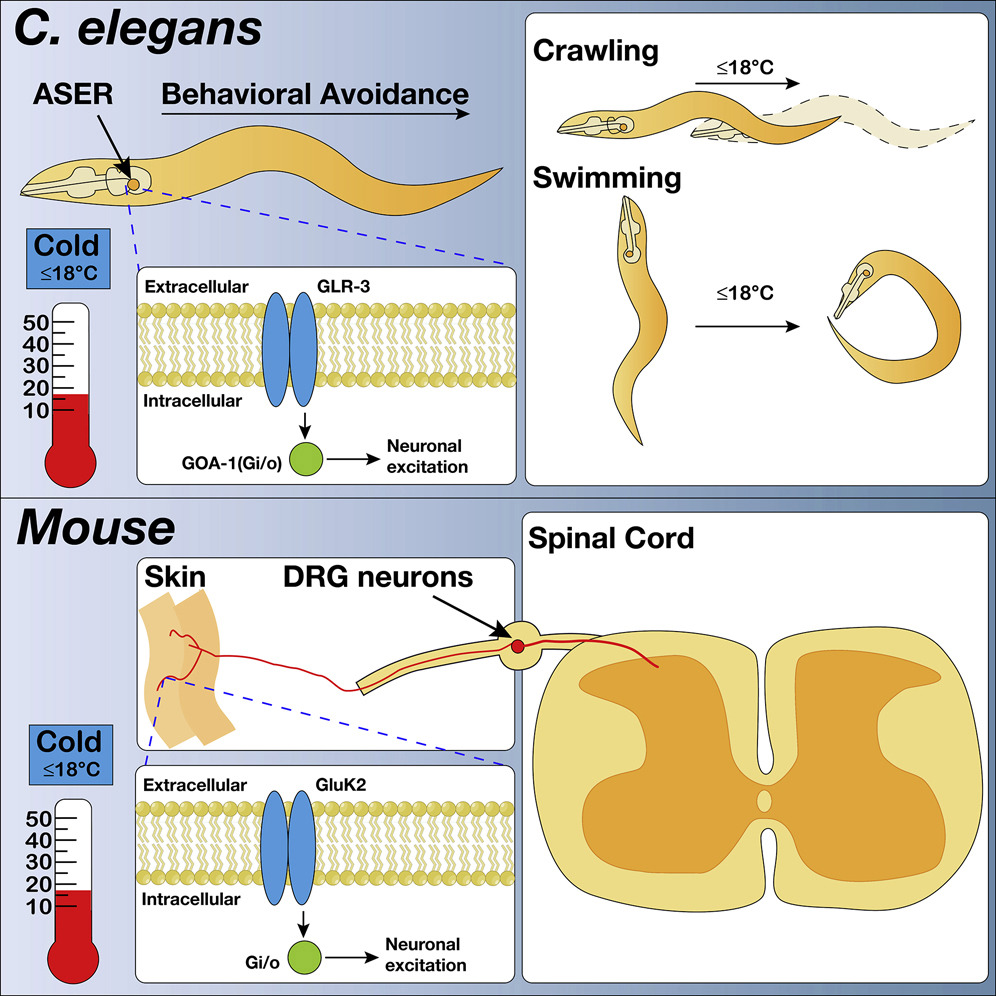 A Cold-Sensing Receptor Encoded by a Glutamate Receptor Gene.Cell, Sep 2019
EXPAND ABSTRACT
Abstract: In search of the molecular identities of cold-sensing receptors, we carried out an unbiased genetic screen for cold-sensing mutants in C. elegans and isolated a mutant allele of glr-3 gene that encodes a kainate-type glutamate receptor. While glutamate receptors are best known to transmit chemical synaptic signals in the CNS, we show that GLR-3 senses cold in the peripheral sensory neuron ASER to trigger cold-avoidance behavior. GLR-3 transmits cold signals via G protein signaling independently of its glutamate-gated channel function, suggesting GLR-3 as a metabotropic cold receptor. The vertebrate GLR-3 homolog GluK2 from zebrafish, mouse, and human can all function as a cold receptor in heterologous systems. Mouse DRG sensory neurons express GluK2, and GluK2 knockdown in these neurons suppresses their sensitivity to cold but not cool temperatures. Our study identifies an evolutionarily conserved cold receptor, revealing that a central chemical receptor unexpectedly functions as a thermal receptor in the periphery.
2016
- Insulin signaling genes modulate nicotine-induced behavioral responses in Caenorhabditis elegans.Behavioural Pharmacology, Feb 2016
EXPAND ABSTRACT
Abstract: Insulin signaling has been suggested to modulate nicotine dependence, but the underlying genetic evidence has been lacking. Here, we used the nematode, Caenorhabditis elegans, to investigate whether genetic alterations in the insulin signaling pathway affect behavioral responses to nicotine. For this, we challenged drug-naive C. elegans with an acute dose of nicotine (100 micromol/l) while recording changes in their locomotion speed. Although nicotine treatment stimulated locomotion speed in wild-type C. elegans, the same treatment reduced locomotion speed in mutants defective in insulin signaling. This phenotype could be suppressed by mutations in daf-16, a gene encoding a FOXO transcription factor that acts downstream of insulin signaling. Our data suggest that insulin signaling genes, daf-2, age-1, pdk-1, akt-1, and akt-2, modulate behavioral responses to nicotine in C. elegans, indicating a genetic link between nicotine behavior and insulin signaling.
2015
- RNAi Interrogation of Dietary Modulation of Development, Metabolism, Behavior, and Aging in C. elegans.Cell Reports, May 2015
EXPAND ABSTRACT
Abstract: Diet affects nearly every aspect of animal life such as development, metabolism, behavior, and aging, both directly by supplying nutrients and indirectly through gut microbiota. C. elegans feeds on bacteria, and like other animals, different bacterial diets induce distinct dietary responses in the worm. However, the lack of certain critical tools hampers the use of worms as a model for dietary signaling. Here, we genetically engineered the bacterial strain OP50, the standard laboratory diet for C. elegans, making it compatible for dsRNA production and delivery. Using this RNAi-compatible OP50 strain and the other bacterial strain HT115, we feed worms different diets while delivering RNAi to interrogate the genetic basis underlying diet-dependent differential modulation of development, metabolism, behavior, and aging. We show by RNAi that neuroendocrine and mTOR pathways are involved in mediating differential dietary responses. This genetic tool greatly facilitates the use of C. elegans as a model for dietary signaling. - Environmental Temperature Differentially Modulates C. elegans Longevity through a Thermosensitive TRP Channel.Cell Reports, Jun 2015
EXPAND ABSTRACT
Abstract: Temperature profoundly affects aging in both poikilotherms and homeotherms. A general belief is that lower temperatures extend lifespan, whereas higher temperatures shorten it. Although this "temperature law" is widely accepted, it has not been extensively tested. Here, we systematically evaluated the role of temperature in lifespan regulation in C. elegans. We found that, although exposure to low temperatures at the adult stage prolongs lifespan, low-temperature treatment at the larval stage surprisingly reduces lifespan. Interestingly, this differential effect of temperature on longevity in larvae and adults is mediated by the same thermosensitive TRP channel TRPA-1 that signals to the transcription factor DAF-16/FOXO. DAF-16/FOXO and TRPA-1 act in larva to shorten lifespan but extend lifespan in adulthood. DAF-16/FOXO differentially regulates gene expression in larva and adult in a temperature-dependent manner. Our results uncover complexity underlying temperature modulation of longevity, demonstrating that temperature differentially regulates lifespan at different stages of life.
Tissue Engineering (Larkin Lab, MS)
2015
- Fresh versus frozen engineered bone-ligament-bone grafts for sheep anterior cruciate ligament repair.Tissue Engineering. Part C, Methods, Jun 2015
EXPAND ABSTRACT
Abstract: Surgical intervention is often required to restore knee instability in patients with anterior cruciate ligament (ACL) injury. The most commonly used grafts for ACL reconstruction are tendon autografts or allografts. These current options, however, have shown failure rates requiring revision and continued instability in the long term. The mismatched biomechanical properties of the current tendon grafts compared with native ACL tissue are thought to contribute to these poor outcomes and potential risk of early onset osteoarthritis. As a possible solution to these issues, our laboratory has fabricated tissue-engineered ligament constructs that exhibit structural and functional properties similar to those of native ACL tissue after 6 months implantation. In addition, these tissue-engineered grafts achieve vascular and neural development that exceeds those of patellar tendon grafts. However, the utility of our tissue-engineered grafts is limited by the labor-intensive method required to produce the constructs and the need to use the constructs fresh, directly from the cell culturing system. Ideally, these constructs would be fabricated and stored until needed. Thus, in this study, we investigated the efficacy of freezing our tissue-engineered constructs as a method of preservation before use for ACL reconstruction. We hypothesized that frozen constructs would have similar histological and biomechanical outcomes compared with our fresh model. Our results showed that 6 months postimplantation as an ACL replacement graft, both our tissue-engineered fresh and frozen grafts demonstrated similar mechanical and histological outcomes, indicating that freezing is a suitable method for preserving and storing our graft before ACL reconstruction. The ability to use frozen constructs significantly increases the versatility of our graft technology expanding the clinical utility of our graft.